Genetic engineering has long been a favorite topic for Hollywood screenwriters to exploit to make box office hits. From Jurassic Park to Deep Blue Sea, film writers recognize that science fiction, or genetic engineering fiction, sells. There’s even a channel dedicated to science fiction, in which the science of biotechnology frequently makes a cameo.
In the eyes of screenwriters, CRISPR offers another opportunity. And “Rampage”, starring Dwayne “The Rock” Johnson, appears to be Hollywood’s first attempt at misconstruing gene editing technology to entertain film lovers. In short, the film focuses on gene edited animals – instead of lions, tigers and bears, think gorillas, crocodiles and wolves – that have been altered to be huge, deadly and downright mean.
Megan Theikling and Andrew Joseph from STAT News were lucky enough to catch an advanced screening of the film and sat down to discuss what the film’s directors got right and wrong about CRISPR. For argument’s sake, the reporters entertain some of the genetic changes that are paramount to the movie, however, they note that many of the mutations in the film aren’t really based on science. As Andrew explains:
“The idea is that the biotech company “weaponized” CRISPR research and introduced the genes of a bunch of other animals into our three monster-animals to give them traits such as those bat wings, or the spikes of some other animal, or the strength or regenerative abilities of certain kinds of bugs. This is all explained very quickly in some exposition by our disgraced yet heroic geneticist played by Naomie Harris. “I’m talking about extremely specific results,” says Naomie.
“One question I have is whether these animal features are polygenic as opposed to tied to one gene. That would make it a lot harder to introduce them into another species… Whether it [CRISPR] could be used to double the size of a gorilla overnight, well, that might be a different story…”
“The CRISPR’d animals of “Rampage” also become super aggressive, and behavior might be harder to change through editing. Maybe they just ramped up testosterone production somehow? I don’t know, Naomie didn’t explain that part.”
As Megan notes, the changes that can be made though gene editing aren’t the only things the film’s writers took creatively liberties with. She begs the question: Where are the regulators?
“All of the CRISPR work in this movie seemed to be WILDLY unregulated. There’s no FDA cameo here. There’s no Scott Gottlieb in skinny jeans.”
“In real life, there’s a whole system that keeps research in the U.S. involving CRISPR in check. The Food and Drug Administration and the National Institutes of Health regulate CRISPR as it relates to medical research, of course. But the Environmental Protection Agency and the Department of Agriculture also play a role in overseeing uses of CRISPR. And the Department of Defense – which is interested in genome-editing as a potential bioterrorism threat – has poured a lot of money into CRISPR research. So there are a lot of people overseeing this kind of work.”
And as Megan goes on to mention, the film’s producers relied more on fiction than on science when developing their plot:
“And as much as I absolutely loved this movie – I will be seeing it at least four more times in theaters, thanks MoviePass – I do think it played fast and loose with some of the science around CRISPR, which is a real thing that actually exists. I know it’s science fiction, but the closest thing I could find on the crew list to a science adviser was a “genetics lab tech advisor.”
Even “The Rock” himself weighed in on the movie’s use of CRISPR as a scientific background, making light of the fact that he doesn’t always remember what the acronym means:
Great RAMPAGE review from my fellow Science majors. We wanted to utilize real CRISPR technology as our scientific backdrop. Of course I still screw up what this acronym means.
Let’s start with the facts: Andy Cohen’s Watch What Happens Live is one of the juiciest talk shows to ever grace our TVs.
Bravo
Cohen often plays a game with his guests called “Plead the Fifth.” He asks them three tough questions, and they can only refuse to answer one of them. Here are some truly WILD things we’ve learned about celebs from this blessed game.
Bravo
Nick Lachey confessed that when he was married to Jessica Simpson, they would do ~hand stuff~ under the table on Easter Sunday – right in front of Joe Simpson.
“The best thing about not having Joe Simpson anymore as a father-in-law is I don’t have to play to grab-ass under the table on Easter Sunday,” he said.
Susan Sarandon said she gets stoned before almost every single Hollywood event – except the Academy Awards.
“I would say, almost all except the Oscars.”
Bravo
Matthew Perry revealed the one Friends storyline he refused to take part in.
“There was a storyline on Friends where Chandler went to a male strip joint because he really liked the sandwiches. And I called up and I said, ‘Let’s not do this one.'”
Bravo
JLo said she’d rather see Britney’s Vegas show than Mariah’s.
When asked whose show she would go to first, JLo said: “Britney, ’cause she dances.”
Bravo
Anna Hathaway admitted that she’s definitely a stoner.
When Andy Cohen asked her to rate her stoner-ness on a scale of 1-10, Anne teased, “I’m not a little one.”
Bravo
Cameron Diaz confirmed that she’s had some same-sex experiences.
“Yes, I have been with a lady,” she said.
Bravo
Kim Kardashian confessed to being relieved when Kylie and Tyga broke up.
“It doesn’t mean he’s a bad person at all, I just think that sometimes people…” she trailed off. “And what was great was that it was so easy – that split. There has not been any drama with her since.”
Andy pointed out that the former athlete wears a size 23 shoe and asked how big his dick is. Shaq took off his shoe, held it up to his ~crotchular region~, and said, “Let me show you.”
Bravo
Pink revealed that one time Christina Aguilera tried to punch her in a club.
“I was like ‘What’s happening right now? What’s happening?'”
Bravo
John Mayer said that if he was going to have sex with any man, he would choose Ryan Gosling.
“Everybody would be like, ‘How does that guy do it?'”
Bravo
Kelly Clarkson ~implied~ that her cover of Taylor Swift’s “Shake It Off” was better than the original.
The question was: “Name one cover you’ve done that you think is better than the original.” After lots and lots of stalling, Kelly finally answered: “I feel like I did a real good version of ‘Shake It Off.’ I feel like I nailed that one.”
Bravo
Demi Lovato addressed that time she famously unfollowed Selena Gomez on Twitter.
“I think it’s just one of those things where people changed and people grow apart.”
Bravo
Jimmy Fallon confirmed that he knows why Justin Timberlake and Britney Spears broke up – but he refused to say the reason on air.
“We used to hang out all the time, with Britney as well… I remember going to a Super Bowl party at Planet Hollywood that Britney and Justin were having. It was just really funny.”
Bravo
Craig Ferguson said Macy Gray was the worst guest he ever had on his late night show.
“I think she was in a bad mood that night. Yeah. I don’t think she’s a bad person…And I was very new, and I couldn’t handle it. But now I think it would be okay.”
Bravo
Michael Bublé revealed that he’s sent many a dick pic.
“Oh, are you kidding me? The question isn’t what have I sent – it’s what haven’t I sent.”
Bravo
Kevin Hart said that he once spent $15,000 at a strip club in a single night.
“I would say probably, like, 15. 15K. But I was treating friends. I had a bunch of friends in town and I wanted to show my friends a good time.”
Bravo
Mariah Carey responded to Demi Lovato saying that she “disses people” and is “nasty.”
“I don’t know her either and so I wouldn’t say anything to her. She should come up, introduce herself to me, say, ‘Here’s my opinion, what do you think about it?’ That’s how you handle shit. Okay?”
Bravo
Christina Applegate admitted that she once ditched a date with Brad Pitt to meet up with another famous dude (but she would not reveal his name).
“I have to say it? I don’t have to do nothing,” she joked.
Bravo
50 Cent said that Jay-Z was the most overrated hip-hop artist of all time.
“I mean, Jay-Z. He would say he’s overrated. ‘Rather be overrated than underpaid,'” 50 explained, referencing Jay-Z’s verse on “So Appalled.”
Bravo
And finally, Gerard Butler said Jennifer Aniston is a better kisser than Angelina Jolie.
He’s kissed them both in movies, so he would know!
In a recent piece for Foreign Affairs, philanthropist and tech pioneer Bill Gates discusses the role that gene editing can play in solving some of the world’s toughest challenges.
From allowing smallholder farmers to advance their agriculture and farming practices to feed their families and communities, to helping doctors better diagnose patients to prevent and treat diseases such as malaria, the extent in which gene editing tools like CRISPR can solve today’s global problems is promising.
Noting the progress that can still be made, however, Bill Gates argues that we must continue encouraging innovation in gene editing if we are to “save millions of lives and empower millions of people to lift themselves out of poverty”:
Today, more people are living healthy, productive lives than ever before. This good news may come as a surprise, but there is plenty of evidence for it. Since the early 1990s, global child mortality has been cut in half. There have been massive reductions in cases of tuberculosis, malaria, and HIV/AIDS. The incidence of polio has decreased by 99 percent, bringing the world to the verge of eradicating a major infectious disease, a feat humanity has accomplished only once before, with smallpox. The proportion of the world’s population in extreme poverty, defined by the World Bank as living on less than $1.90 per day, has fallen from 35 percent to about 11 percent.
Continued progress is not inevitable, however, and a great deal of unnecessary suffering and inequity remains. By the end of this year, five million children under the age of five will have died-mostly in poor countries and mostly from preventable causes. Hundreds of millions of other children will continue to suffer needlessly from diseases and malnutrition that can cause lifelong cognitive and physical disabilities. And more than 750 million people-mostly rural farm families in sub-Saharan Africa and South Asia-still live in extreme poverty, according to World Bank estimates. The women and girls among them, in particular, are denied economic opportunity.
Some of the remaining suffering can be eased by continuing to fund the development assistance programs and multilateral partnerships that are known to work. These efforts can help sustain progress, especially as the world gets better at using data to help guide the allocation of resources. But ultimately, eliminating the most persistent diseases and causes of poverty will require scientific discovery and technological innovations.
That includes CRISPR and other technologies for targeted gene editing.
“Over the next decade, gene editing could help humanity overcome some of the biggest and most persistent challenges in global health and development.”
The technology is making it much easier for scientists to discover better diagnostics, treatments, and other tools to fight diseases that still kill and disable millions of people every year, primarily the poor. It is also accelerating research that could help end extreme poverty by enabling millions of farmers in the developing world to grow crops and raise livestock that are more productive, more nutritious, and hardier. New technologies are often met with skepticism. But if the world is to continue the remarkable progress of the past few decades, it is vital that scientists, subject to safety and ethics guidelines, be encouraged to continue taking advantage of such promising tools as CRISPR.
FEEDING THE WORLD
Earlier this year, I traveled to Scotland, where I met with some extraordinary scientists associated with the Centre for Tropical Livestock Genetics and Health at the University of Edinburgh. I learned about advanced genomic research to help farmers in Africa breed more productive chickens and cows. As the scientists explained, the breeds of dairy cows that can survive in hot, tropical environments tend to produce far less milk than do Holsteins-which fare poorly in hot places but are extremely productive in more moderate climates, thanks in part to naturally occurring mutations that breeders have selected for generations. The scientists in Scotland are collaborating with counterparts in Ethiopia, Kenya, Nigeria, Tanzania, and the United States. They are studying ways to edit the genes of tropical breeds of cattle to give them the same favorable genetic traits that make Holsteins so productive, potentially boosting the tropical breeds’ milk and protein production by as much as 50 percent. Conversely, scientists are also considering editing the genes of Holsteins to produce a sub-breed with a short, sleek coat of hair, which would allow the cattle to tolerate heat.
This sort of research is vital, because a cow or a few chickens, goats, or sheep can make a big difference in the lives of the world’s poorest people, three-quarters of whom get their food and income by farming small plots of land. Farmers with livestock can sell eggs or milk to pay for day-to-day expenses. Chickens, in particular, tend to be raised by women, who are more likely than men to use the proceeds to buy household necessities. Livestock help farmers’ families get the nutrition they need, setting children up for healthy growth and success in school.
Similarly, improving the productivity of crops is fundamental to ending extreme poverty. Sixty percent of people in sub-Saharan Africa earn their living by working the land. But given the region’s generally low agricultural productivity-yields of basic cereals are five times higher in North America-Africa remains a net importer of food. This gap between supply and demand will only grow as the number of mouths to feed increases. Africa’s population is expected to more than double by 2050, reaching 2.5 billion, and its food production will need to match that growth to feed everyone on the continent. The challenge will become even more difficult as climate change threatens the livelihoods of smallholder farmers in Africa and South Asia.
“Gene editing to make crops more abundant and resilient could be a lifesaver on a massive scale.”
The technology is already beginning to show results, attracting public and private investment, and for good reason. Scientists are developing crops with traits that enhance their growth, reduce the need for fertilizers and pesticides, boost their nutritional value, and make the plants hardier during droughts and hot spells. Already, many crops that have been improved by gene editing are being developed and tested in the field, including mushrooms with longer shelf lives, potatoes low in acrylamide (a potential carcinogen), and soybeans that produce healthier oil.
For a decade, the Bill & Melinda Gates Foundation has been backing research into the use of gene editing in agriculture. In one of the first projects we funded, scientists from the University of Oxford are developing improved varieties of rice, including one called C4 rice. Using gene editing and other tools, the Oxford scientists were able to rearrange the cellular structures in rice plant leaves, making C4 rice a remarkable 20 percent more efficient at photosynthesis, the process by which plants convert sunlight into food. The result is a crop that not only produces higher yields but also needs less water. That’s good for food security, farmers’ livelihoods, and the environment, and it will also help smallholder farmers adapt to climate change.
“Such alterations of the genomes of plants and even animals are not new.”
Humans have been doing this for thousands of years through selective breeding. Scientists began recombining DNA molecules in the early 1970s, and today, genetic engineering is widely used in agriculture and in medicine, the latter to mass-produce human insulin, hormones, vaccines, and many drugs. Gene editing is different in that it does not produce transgenic plants or animals-meaning it does not involve combining DNA from different organisms. With CRISPR, enzymes are used to target and delete a section of DNA or alter it in other ways that result in favorable or useful traits. Most important, it makes the discovery and development of innovations much faster and more precise.
ENDING MALARIA
In global health, one of the most promising near-term uses of gene editing involves research on malaria. Although insecticide-treated bed nets and more effective drugs have cut malaria deaths dramatically in recent decades, the parasitic disease still takes a terrible toll. Every year, about 200 million cases of malaria are recorded, and some 450,000 people die from it, about 70 percent of them children under five. Children who survive often suffer lasting mental and physical impairments. In adults, the high fever, chills, and anemia caused by malaria can keep people from working and trap families in a cycle of illness and poverty. Beyond the human suffering, the economic costs are staggering. In sub-Saharan Africa, which is home to 90 percent of all malaria cases, the direct and indirect costs associated with the disease add up to an estimated 1.3 percent of GDP-a significant drag on countries working to lift themselves out of poverty.
With sufficient funding and smart interventions using existing approaches, malaria is largely preventable and treatable-but not completely. Current tools for prevention, such as spraying for insects and their larvae, have only a temporary effect. The standard treatment for malaria today-medicine derived from artemisinin, a compound isolated from an herb used in traditional Chinese medicine-may relieve symptoms, but it may also leave behind in the human body a form of the malaria parasite that can still be spread by mosquitoes. To make matters worse, the malaria parasite has begun to develop resistance to drugs, and mosquitoes are developing resistance to insecticides.
Efforts against malaria must continue to make use of existing tools, but moving toward eradication will require scientific and technological advances in multiple areas. For instance, sophisticated geospatial surveillance systems, combined with computational modeling and simulation, will make it possible to tailor antimalarial efforts to unique local conditions. Gene editing can play a big role, too. There are more than 3,500 known mosquito species worldwide, but just a handful of them are any good at transmitting malaria parasites between people. Only female mosquitoes can spread malaria, and so researchers have used CRISPR to successfully create gene drives-making inheritable edits to their genes-that cause females to become sterile or skew them toward producing mostly male offspring. Scientists are also exploring other ways to use CRISPR to inhibit mosquitoes’ ability to transmit malaria-for example, by introducing genes that could eliminate the parasites as they pass through a mosquito’s gut on their way to its salivary glands, the main path through which infections are transmitted to humans. In comparable ways, the tool also holds promise for fighting other diseases carried by mosquitoes, such as dengue fever and the Zika virus.
It will be several years, however, before any genetically edited mosquitoes are released into the wild for field trials. Although many questions about safety and efficacy will have to be answered first, there is reason to be optimistic that creating gene drives in malaria-spreading mosquitoes will not do much, if any, harm to the environment. That’s because the edits would target only the few species that tend to transmit the disease. And although natural selection will eventually produce mosquitoes that are resistant to any gene drives released into the wild, part of the value of CRISPR is that it expedites the development of new approaches-meaning that scientists can stay one step ahead.
THE PATH FORWARD
Like other new and potentially powerful technologies, gene editing raises legitimate questions and understandable concerns about possible risks and misuse. How, then, should the technology be regulated? Rules developed decades ago for other forms of genetic engineering do not necessarily fit.
“Noting that gene-edited organisms are not transgenic, the U.S. Department of Agriculture has reasonably concluded that genetically edited plants are like plants with naturally occurring mutations and thus are not subject to special regulations and raise no special safety concerns.”
Gene editing in animals or even humans raises more complicated questions of safety and ethics. In 2014, the World Health Organization issued guidelines for testing genetically modified mosquitoes, including standards for efficacy, biosafety, bioethics, and public participation. In 2016, the National Academy of Sciences built on the WHO’s guidelines with recommendations for responsible conduct in gene-drive research on animals. (The Gates Foundation co-funded this work with the National Institutes of Health, the Foundation for the National Institutes of Health, and the Defense Advanced Research Projects Agency.) These recommendations emphasized the need for thorough research in the lab, including interim evaluations at set points, before scientists move to field trials. They also urged scientists to assess any ecological risks and to actively involve the public, especially in the communities and countries directly affected by the research. Wherever gene-editing research takes place, it should involve all the key stakeholders-scientists, civil society, government leaders, and local communities-from wherever it is likely to be deployed.
Part of the challenge in regulating gene editing is that the rules and practices in different countries may differ widely. A more harmonized policy environment would prove more efficient, and it would probably also raise overall standards. International organizations, especially of scientists, could help establish global norms. Meanwhile, funders of gene-editing research must ensure that it is conducted in compliance with standards such as those advanced by the WHO and the National Academy of Sciences, no matter where the research takes place.
When it comes to gene-editing research on malaria, the Gates Foundation has joined with others to help universities and other institutions in the regions affected by the disease to conduct risk assessments and advise regional bodies on experiments and future field tests. The goal is to empower affected countries and communities to take the lead in the research, evaluate its costs and benefits, and make informed decisions about whether and when to apply the resulting technology.
Finally, it’s important to recognize the costs and risks of failing to explore the use of new tools such as CRISPR for global health and development. The benefits of emerging technologies should not be reserved only for people in developed countries. Nor should decisions about whether to take advantage of them.
“Used responsibly, gene editing holds the potential to save millions of lives and empower millions of people to lift themselves out of poverty. It would be a tragedy to pass up the opportunity.”
Investors sentiment increased to 1.65 in Q4 2017. Its up 0.10, from 1.55 in 2017Q3. It is positive, as 13 investors sold Puma Biotechnology, Inc. shares while 50 reduced holdings. 40 funds opened positions while 64 raised stakes. 34.70 million shares or 2.80% less from 35.70 million shares in 2017Q3 …
When looking at the past few years’ web designs, you can’t help but notice a pattern of bright colors, asymmetric shapes, and duotones, Truly unique website designs are trending right now. And what’s bolder than taking your words that just lie there flat most of the time and making them into vertical text?
So let’s dig in on today’s tutorial and see what it’s gonna take to get #verticaltext trending.
What You’ll Be Making
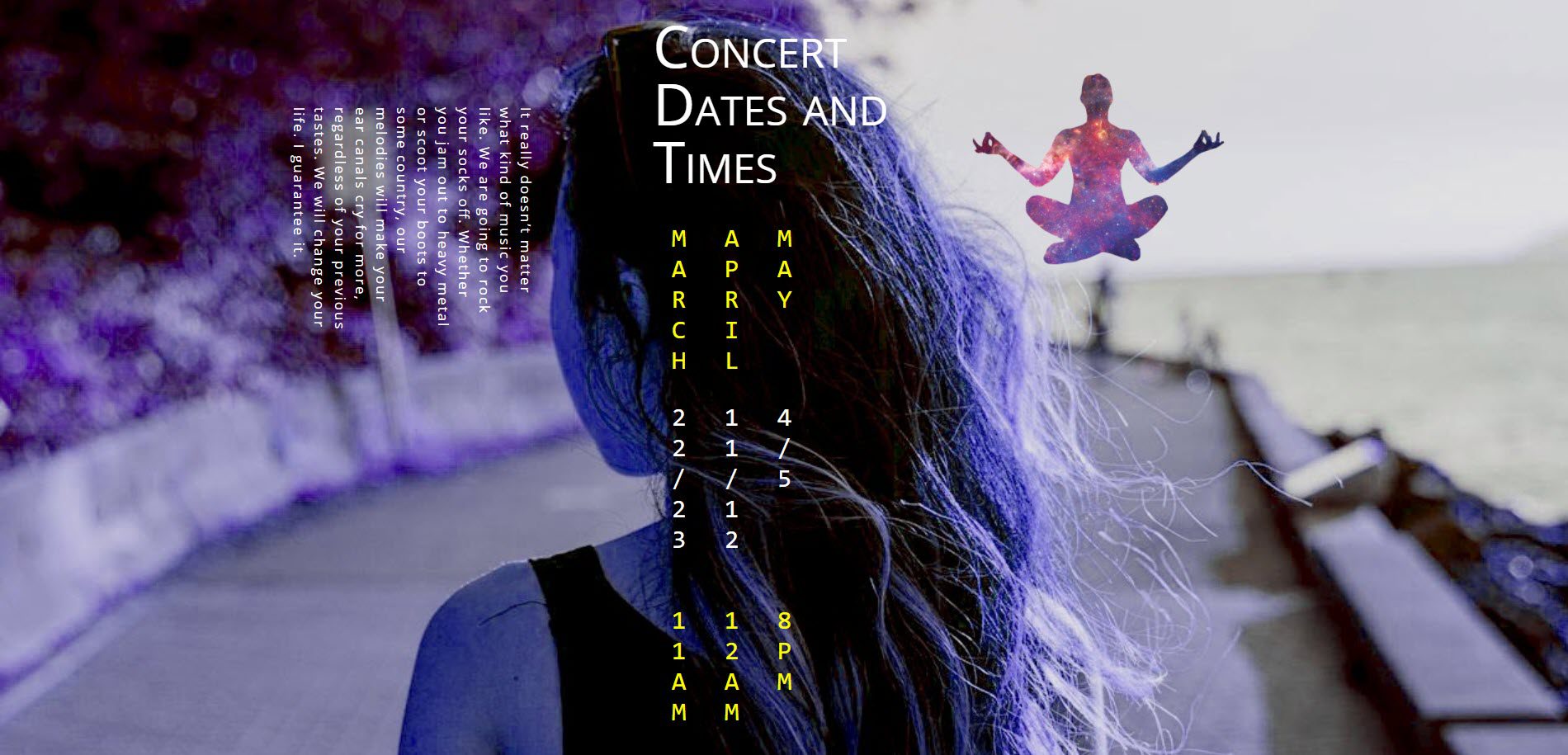
The final result of what I’m walking you through today is simple, clean, and – dare I say it? – elegant. Vertical text is not an effect you want to overuse, so I am thinking of it being maybe a concert schedule, or maybe a listing of class times. Even a food truck menu or location schedule. Basically any information that is quick and needs to be both eye-catching and memorable.
Now let’s get to making it happen for you!
Using Sideways and Vertical Text to Create a Unique Landing Page with Divi
When you open up a new page in Divi, you’re presented with an almost-blank canvas. You start with a regular section. But we don’t want a regular section. We want a specialty section. So hit the blue + circle, click the specialty section button in the middle, and choose the very last one in the new modal. Then delete that boring old regular section.
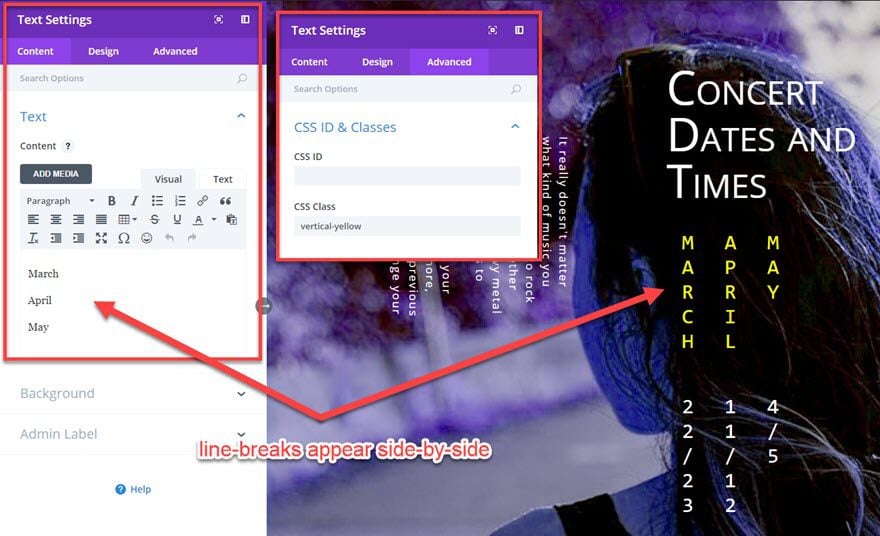
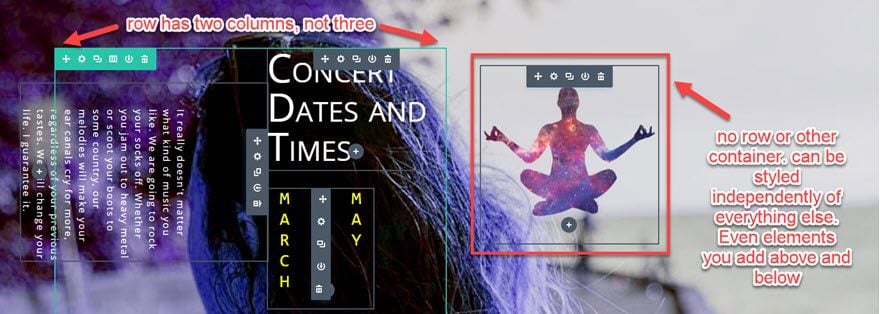
Now, you’re left with a shiny, orange specialty section that’s gonna treat you like you deserve to be treated – special. Inside it, here’s what you want to add: a two-column row with 1 text module in the left column and 4 text modules in the right one. Then you’ll use a single image module in the stand-alone spot to the right.
Also, take note: this is Wireframe View inside the visual builder, and it works just like the back-end builder, but it’s faster. If you haven’t tried it, please give it a shot. It’s really awesome.
Next Stop: Custom CSS
Even if you’re not totally into CSS, these snippets are simple to use and implement, and I’ve made sure to comment the code so you know what each line does. Be aware that the WP built-in linter does not like text-orientation: upright;. Without it, this won’t work. This is one case you can ignore that yellow triangle.
.sideways-text { transform: rotate(90deg); /* makes entire paragraphs and lines rotate sideways */ }
.vertical-yellow { text-orientation: upright; /* makes individual characters stand upright, not whole lines like transform: rotate */ writing-mode: vertical-lr; /* continues left-to-right at line break */ color: yellow; font-size:2rem; /* this will make the body text twice the relative size of the default set for the whole site */ line-height: 200%; /* line height is VISUALLY line-width when it's vertical */ text-transform: uppercase; font-family: monospace; /* this just pretties up the whole deal, making all characters the same width */ }
You can copy and paste this code into your Divi Theme Options’ Custom CSS field (under the General tab).
Feel free to adjust the class names and colors as you need to for your design. I just liked the way yellow and white looked with the background I used. Speaking of the background…
Making Your Background
I think these kinds of bold sites look awesome with not-so-natural color palettes. Duotones are really on trend right now, so I wanted something like that. There are lots of ways to adjust your images’ colors to duotone, but Flywheel has an awesome tutorial on how to use Photoshop to make one. This time, however, I didn’t use Photoshop – I just played around in Snagit and made something I liked.
I used one of Joy’s amazing photos as a base. (Feel free to download this image and use it however you want, too!). Here’s the original:
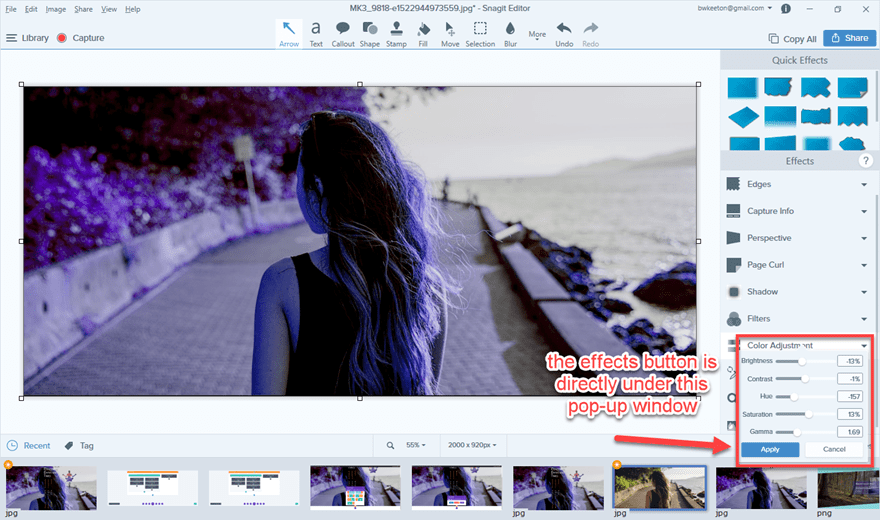
I cropped it down a little (to 2000×920 from 2000×1333), and opened up the Effects window in the lower-right corner and played with the Color Adjustment settings.
Brightness: -13%
Contrast: -1%
Hue: -157
Saturation: 13%
Gamma: 1.69
It’s not quite a duotone, but it gave me the same kind of palette to work with.
Once that was done, I went to buildin’ with Divi.
Makin’ It With Divi
Like our text, let’s just start at the top-left and work our way down the page. First up, I made sure to label all the modules for you in the Admin Label section of the module settings. You can also type it in-line using Wireframe View.
Sideways Text
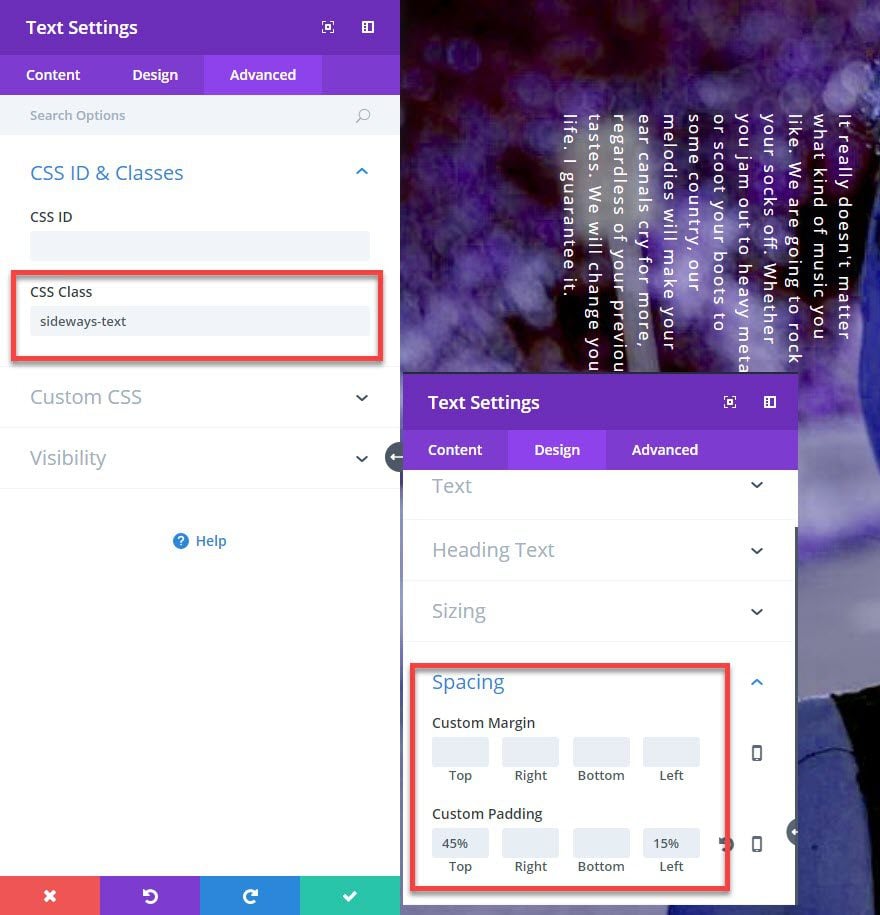
We made the sideways text with a single line of CSS: transform: rotate(90deg); Notice that it’s not a text-transform, just transform. That means anything – images, videos, etc. – in this module will be rotated 90 degrees. (Or the amount you put in).
For the Divi settings, you want to make these changes:
Design tab, Spacing: 45% top padding, 15% left padding
Advanced tab, CSS ID & Classes: “sideways-text” in the CSS class field (with no “.” to indicate it’s a class)
Upright Headline Text
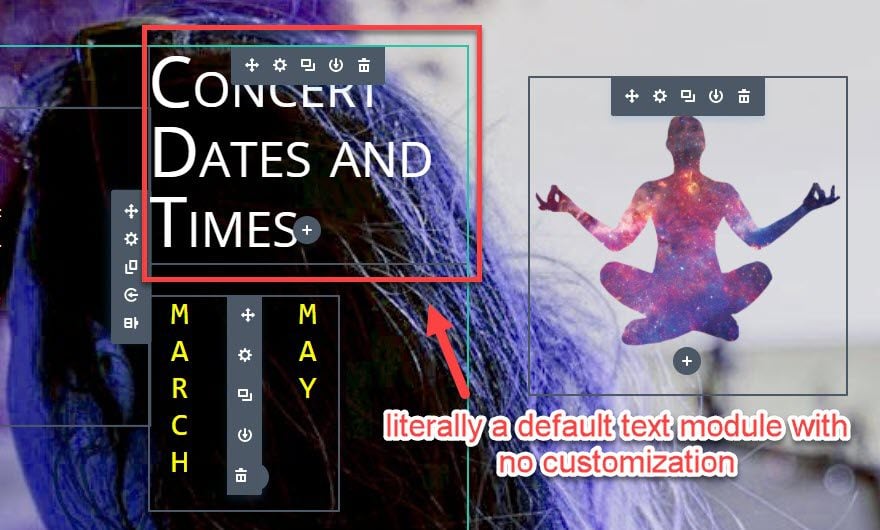
For the Upright Headline Text box…you have to do absolutely nothing. I set this one at H2 and hit save (outside of giving it an Admin Label). (This is Grid View in the Visual Builder in case you were wondering.)
Vertical Months, Dates, Times
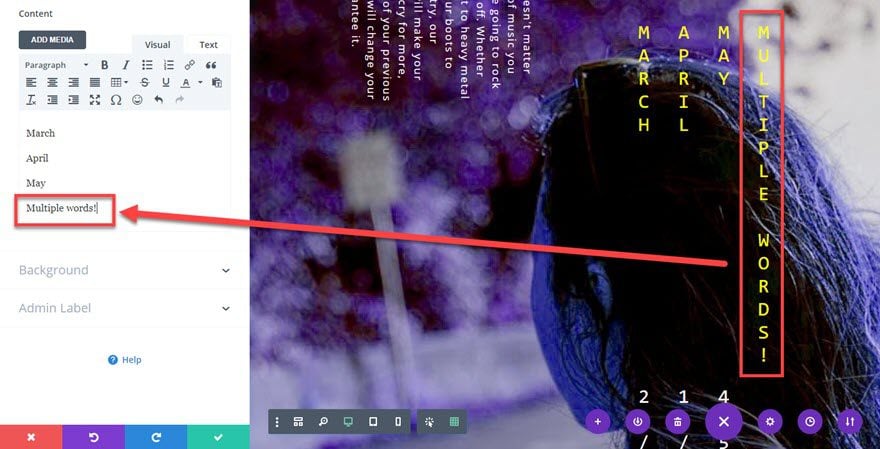
These are, again, text modules stacked on top of one another. Because of the CSS we entered earlier, you can type whatever you want into the content box, and it will come out vertically. When you enter and begin a new paragraph, that will be to the left of the previous one (thanks to the writing-mode: vertical-lr; snippet). If you want the new paragraphs to the right, you can change it to writing-mode: vertical-rl; where the last two letters represent either left-to-right or right-to-left.
This is the same for each and every one of these modules. The only customization I made was adding the vertical-yellow or vertical-white CSS class. The reason for this is that, yes, the CSS we entered with the monospacing and uppercase helps a lot, but the Divi Specialty section is already lined up so that the content is contained well. That’s why I chose to use specialty over normal. It requires a lot less playing with margins and padding and alignment than most sections, rows, and columns usually do.
Now, depending on your background image when you do this, you might have to move stuff around with margins or different specialty sections. I feel like a center-focused background image works well for this kind of site, but if you have one where the main element is to the left or right (or top or bottom, even), positioning may require a little more tweaking.
One other thing: you can also type multiple words. This example just happens to be one word per line. Whole sentences are fine, though harder to read. Keep it short, but you’re not limited to only solo words.
The Lone Image Module
I think of this adding a module over here as optional. It’s there as part of the specialty section, and I think a logo looks nice in most cases. However, if you want to leave it blank, you can. The spacing that the Divi specialty section provides keeps the rest of the page lined up regardless. This one isn’t in a row, which means it’s independent of the styling and spacing you give that container and elements that you place above and below it.
Final Result
I think you’ll be proud of the stuff you can create with these neat effects. Here’s what the above steps will get you, once again.
There You Have It
When you combine the ridiculous number of options you get from Divi (like specialty sections) with just a couple cool (and kind of obscure) lines of CSS, you can make some really unique pages. While this effect is absolutely not right for every site, the inclusion of sideways and vertical text can really make pages stand out and be more memorable than a traditional landing page. So go forth, Divi Nation, and see what cool stuff you can do with vertical text and sidways rotations.
What cool effects have you been able to make with sideways or vertical text?
Amgen Inc. (NASDAQ:AMGN) and Skyworks Solutions, Inc. (NASDAQ:SWKS) are the two most active stocks in the Biotechnology industry based on today’s trading volumes. Investors are clearly interested in the two names, but is one a better choice than the other? We will compare the two companies …
The world is getting warmer and the population is growing exponentially. The United Nations predicts that the world’s population will increase by more than 2 billion by 2050, drastically driving up our demand for food. And this challenge will only be compounded by global warming. Thanks to biotechnology, primarily genetic modification and gene editing, however, the future may not be so grim.
As Kevin Doxzen, a science communicator at the Innovative Genomics Institute, writes in a piece for the San Francisco Chronicle, genetic modification can help maintain our food supply in the wake of shifting climates:
The California drought of recent years has shown us the precious value of water, which can disappear as quickly as it can arrive. Several varieties of GMO crops can not only survive but also thrive in dry areas – helping to reduce irrigation and water use. On the opposite end of the spectrum, researchers have engineered rice that can grow in overly flooded rice paddy fields, a common occurrence in Asia. As our climate changes, monsoons are intensifying and droughts are lasting longer. Under these dire circumstances, genetically modified agriculture provides an avenue to feed Earth’s 7.6 billion people in both developing and industrialized nations.
And as climates change, farmers will be forced to move their farms, creating another challenge that can be stifled by GM crops (italics added):
As the planet warms, land suitable for agriculture slowly migrates north in latitude and higher in elevation. When farmers plant their crops at these higher altitudes, where the air is cooler and more humid, crops can encounter new species of bacteria, fungus and insects. In pursuit of sustainability, genetically modified crops (i.e. disease resistance, insect resistance) can boost the environment by minimizing crop devastation from pests and thus reducing food waste.
In looking to the future, Doxzen explains how scientists are using biotechnology to increase yields to create a more stable food supply:
By altering only one sequence of DNA, researchers in New York developed tomato plants that sprouted additional branches, leading to more tomatoes. By altering only one additional sequence of DNA, tomatoes stayed on the branch longer without prematurely falling off. These two changes help farmers improve their yield and revenue by harvesting more tomatoes per acre of land and by collecting them all at once so a fraction of the crop isn’t left to decay on the ground.
If we are to feed the world’s population by 2050, in the midst of a warming world, we must continue to harness agricultural innovation. We can’t rely on only one form of farming to do so. We must explore all options, especially GM crops.
Breda, the Netherlands / Ghent, Belgium – argenx (Euronext & Nasdaq: ARGX), a clinical-stage biotechnology company developing a deep pipeline of differentiated antibody-based therapies for the treatment of severe autoimmune diseases and cancer, today announced the appointment of R. Keith …
Jimmy Kimmel gets into heated Twitter war with Sean Hannity – now even liberals are angry at him. 3 hours … Late-night television host Jimmy Kimmel sparred with Fox News host Sean Hannity in a brutal Twitter war on Friday. … The two spent Friday trading dozens of very harsh barbs on Twitter.

























 “Over the next decade, gene editing could help humanity overcome some of the biggest and most persistent challenges in